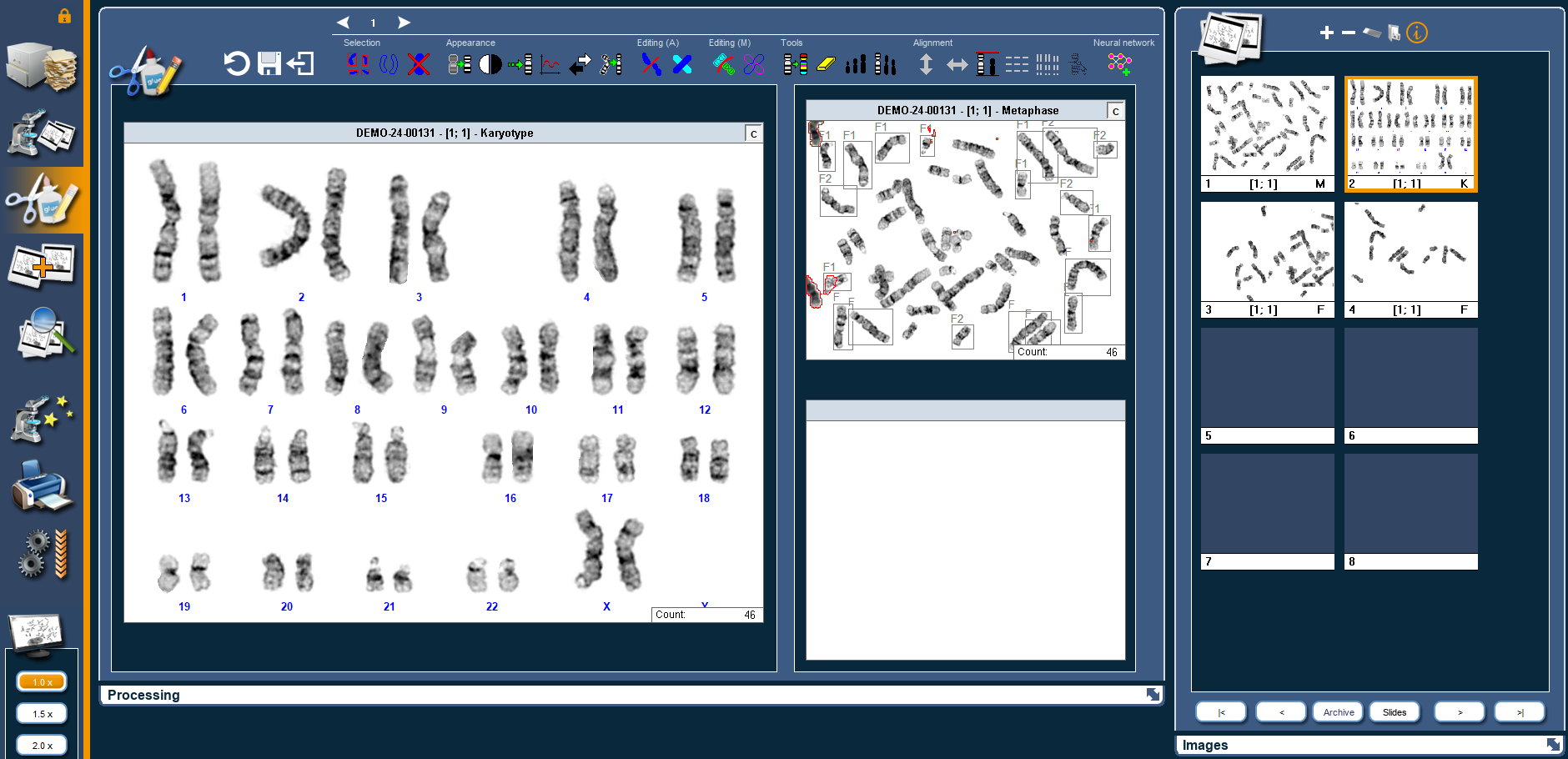
B.01 One case
Linked data, images and results.
Gallery, metaphases, karyotypes, fusions and FISH images stay in the same archive, linked to case, slide and image.
LeafYX · Overview
A software workstation for cytogenetics research: it drives the microscope, camera and motorised stage, archives preparations by case, slide and image, and guides the operator through to the karyotype, the count and the visual analysis.
01 / 06 · Main
Archive, case structure, gallery.
Illustrative animation: not a screenshot of the program.
01 Benefits for the lab
A single program takes the preparation from acquisition to the report, and the choices that matter stay with the operator.
B.01 One case
Gallery, metaphases, karyotypes, fusions and FISH images stay in the same archive, linked to case, slide and image.
B.02 Less repetitive work
The motorised stage scans the slide and returns by itself to the metaphases chosen for high-magnification acquisition.
B.03 Operator review
Separation, classification and karyotype layout are assisted; every chromosome can still be corrected and reclassified.
B.04 Traceability
The audit log writes one line per event, with date, time, user, case and action, always on the workstation.
02 Environments
The main window stays the same: the environment is chosen from a side bar and a top bar. Each card leads to the features in detail.
Case archive, case structure with slides and images, gallery with thumbnails by type: metaphase, karyotype, fusion, composition.
02 AcquisitionLive camera image, control of the microscope and stage, autofocus and automatic metaphase finding.
03 ProcessingMetaphase, karyotype and composition in three areas; chromosome separation, manual and automatic karyotyping, ideograms.
04 FusionChromosomes left outside the image are transferred from the capture to the metaphase, tagged with the label of the fusion they come from.
05 Count and visual analysisOne click per chromosome; the class buttons change appearance according to how many chromosomes they have received.
06 FISHProcessing of FISH images, with configurable fluorochromes and probes.
03 FISH and fluorescence
In fluorescence and FISH, acquisition is per fluorochrome, one channel per filter. The channels are then recombined into a single colour image.
With a motorised filter wheel and, where fitted, LED illumination at configurable wavelengths.
Names and colours of fluorochromes and probes are configurable; the counterstain is selectable.
Measurement of optical density and evaluation of the signal ratio.
04 Trainable classifier
Automatic karyotyping uses a classifier chosen in the options. For each banding type, Q, G and R, the laboratory can use its own model, built on the workstation from the karyotypes it has verified.
05 Configuration and modules
LeafYX drives the motorised microscope, stage, focus, filter wheels and digital camera. The hardware key enables the modules your workflow needs.
06 LeafYX in figures
Classes of the human karyotype: 1–22, X and Y.
Q, G and R, each with its own trainable model.
Ideogram bands, including R bands.
Italian, English, French and German. Other languages on request.
TIFF, JPEG, BMP and TGA for import.
07 Frequently asked questions
More questions? Write to us: we also answer questions about setting up the workstation.
LeafYX is software for cytogenetics research. For Research Use Only (RUO): not a medical device and not for use in diagnostic procedures. The automatic functions produce suggestions that the operator verifies.
You can acquire in brightfield, fluorescence and FISH; in fluorescence and FISH, one channel per fluorochrome. You can also import images from disk in TIFF, JPEG, BMP and TGA formats.
Yes. Each chromosome can be moved, swapped, rotated and flipped by hand, and reclassified.
Cases are stored in a Microsoft SQL Server Express database, on the workstation or on a shared network server. The classifier’s datasets and models are built locally: the images stay on the workstation.
Italian, English, French and German: the program opens in the language of the operating system. Other languages can be added on request.
The new generation of LeafYX is in development, with a renewed interface and full compatibility with existing archives.
LeafYX is software for cytogenetics research. For Research Use Only (RUO): not a medical device and not for use in diagnostic procedures.
The automatic functions produce suggestions: separation, classification, karyotype and count remain under the operator’s verification.
Illustrative animations: not screenshots of the program.
Demo
Contact us for a demonstration, to check your hardware configuration or to define the modules best suited to your lab.